
Short answer: yes, Astro is good for SEO. But not in a magic way. It helps with the technical side, the stuff Google cares about under the hood, and then the rest is still on you.
I’ve moved a few sites from WordPress to Astro now, and the SEO has held and then climbed every time. So here’s what actually makes the difference, and what Astro won’t do for you.
Why Astro helps with SEO
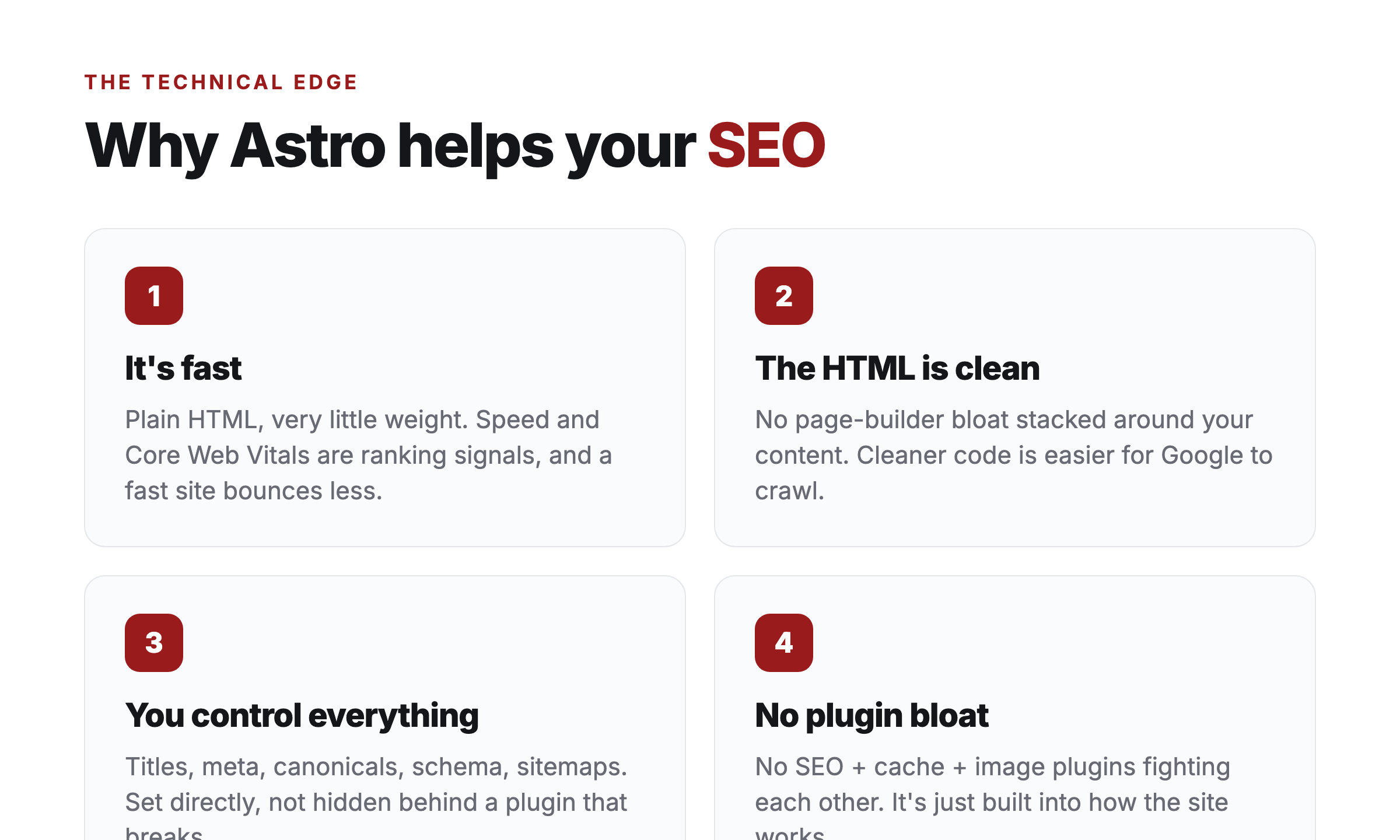
It’s fast. This is the big one. Astro ships plain HTML with very little extra weight, so pages load quickly. Google uses page speed and Core Web Vitals as ranking signals, and a fast site also keeps people from bouncing. On one site, the homepage went from 15 seconds to load down to under 1 second after the move. That’s the kind of gap that shows up in your numbers.
The HTML is clean. WordPress with a page builder stacks up a lot of extra code around your content. Astro builds the page down to mostly just what’s needed. Cleaner HTML is easier for Google to crawl and understand.
You control everything. Titles, meta descriptions, canonical tags, schema, sitemaps, none of it is hidden behind a plugin. You set it directly, so there’s no plugin deciding things for you or breaking on an update.
No plugin bloat or conflicts. On WordPress you often end up with an SEO plugin, a cache plugin, an image plugin, and they don’t always play nice. With Astro that’s just built into how the site works.
What Astro will NOT do for you
This is the honest part. Moving to Astro does not rank you by itself. It gives you a fast, clean foundation, but you still have to do the actual SEO work:
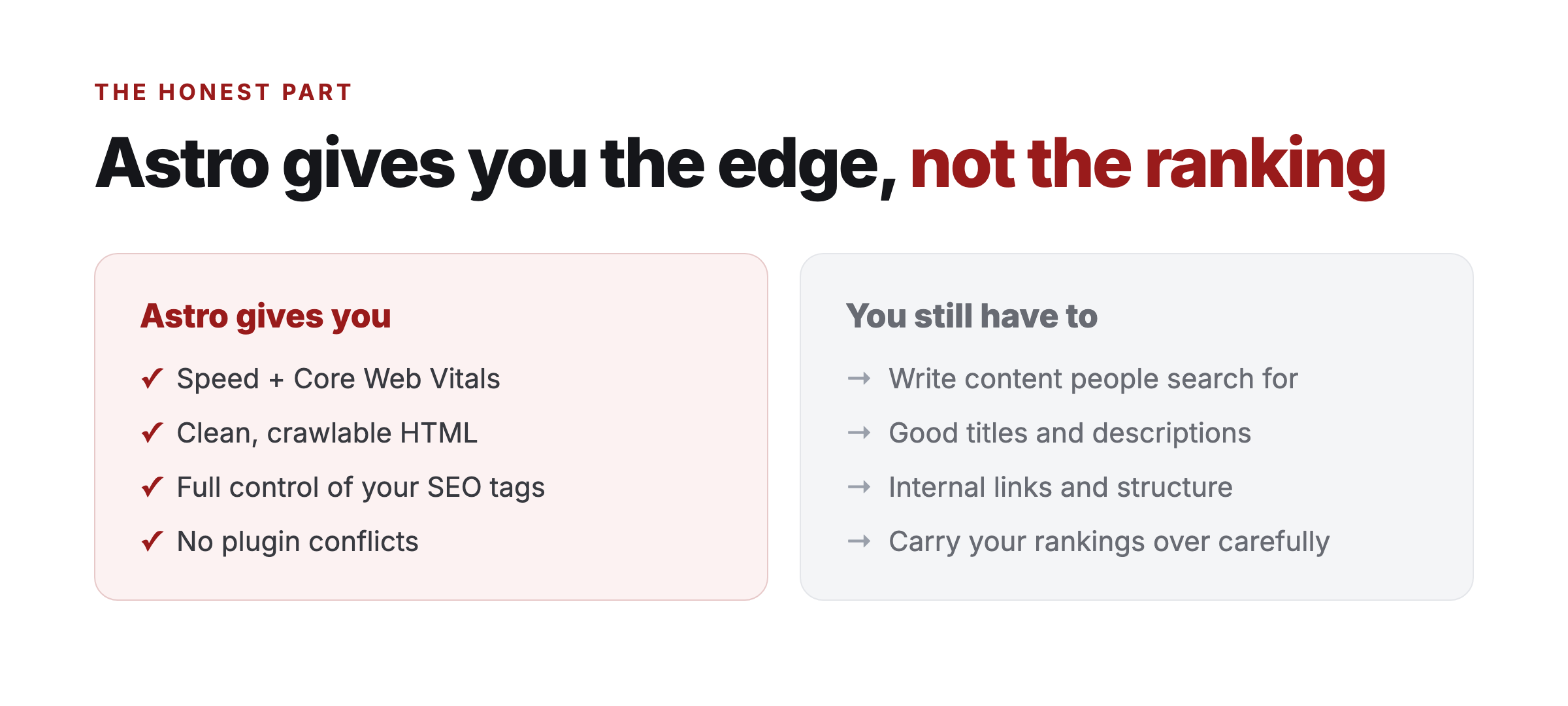
- You still need content people are searching for.
- You still need good titles and descriptions.
- You still need internal links and a sensible structure.
- And if you’re migrating, you still have to carry your rankings over carefully, which is its own job. I wrote the full checklist for that here.
A fast empty site doesn’t rank. A fast site with good content has an edge. Astro gives you the speed and the control. The rest is the same SEO it’s always been.
The thing that surprised me most
The part I didn’t expect was how much easier it is to keep the SEO basics right. Because I update the site by telling AI what to do, things like adding schema, fixing a meta description, or matching a URL are quick. I’m not digging through a plugin settings page. That means the small SEO stuff actually gets done instead of sitting on a to-do list. I went into the whole setup in the agentic website write-up.
Common questions
Is the Astro framework good for SEO? Yes, for the technical side. The Astro framework ships fast, clean HTML and lets you control your titles, meta, canonicals and schema directly, which is exactly the foundation Google likes. It won’t write your content for you, though.
Does moving to Astro improve rankings on its own? No. It gives you a fast, clean base, but a fast empty site doesn’t rank. You still need content people search for, good titles, and sensible internal links. Astro just makes the technical part easier.
Is Astro hard to handle for SEO? Less than you’d think. Because you set the SEO tags directly, and I update the site by telling AI what to do, the small stuff like fixing a meta description or adding schema actually gets done instead of sitting on a list.
Will I lose SEO traffic moving from WordPress to Astro? Not if you migrate carefully. On every move I’ve done the traffic held and then climbed, because I rebuilt the site as an exact copy first. The migration checklist is how I kept it safe.
So is it worth it for SEO?
If your WordPress site is slow and you’re fighting plugins to keep it healthy, then yes, moving to a fast static setup gives you a real technical edge, and in my experience the rankings come with you when you do the migration carefully.
But don’t move just because you heard static sites are good for SEO. Move because your current site is slow or a pain to run, and treat the SEO boost as a bonus on top.
Have you checked your site speed lately? If it’s slow, that’s probably costing you more than you think. Let me know where yours is at.